Hair Transplant in Markham and North York, Ontario
A hair transplant moves your own follicles from the back and sides of your scalp — where hair is genetically resistant to thinning — into areas that have receded or lost density. We perform both FUE and FUT at our two Ontario clinics, and surgical procedures are carried out by physicians registered with the College of Physicians and Surgeons of Ontario.
Our Markham clinic sits on Warden Avenue just north of Steeles, minutes from Highway 404, Highway 407 and Pacific Mall. Our North York clinic is inside Centerpoint Mall at Yonge and Steeles, a short ride north of Finch Station on the TTC Yonge line. Both offer free on-site parking and both run the same assessment.
The assessment is free. You are not committed to surgery by attending, and if we do not think a transplant will give you a result worth the cost, we will tell you that in the room.
From $3,990
+ HST, published
CPSO
Registered physicians
Free
Assessment & consultation

A Permanent Solution for Hair Loss
Hair transplantation is one of the most effective and long-lasting solutions for individuals experiencing significant hair loss. By redistributing healthy hair follicles from donor areas to thinning or bald areas, a hair transplant can restore natural hair growth and improve overall appearance.
At DrHairs, we combine modern transplant techniques with personalized treatment planning to deliver natural-looking results tailored to each patient.
Our focus is to achieve density, natural hairline design, and long-term hair restoration while maintaining the highest medical standards.
Graft estimator Select the closest match to your current stage. Commonly treatable with a single session. Estimates only. Two people at the same stage can need very different graft numbers — donor density, hair calibre and texture all change how much scalp each follicle covers. Your figure is confirmed at your free assessment.
Get Free Quote
How many grafts might you need?
Typical graft range
1,000–1,800
Indicative investment
From $3,990 + HST
Cost Our hair transplant pricing starts at $3,990 plus HST for a smaller session of approximately 1,000 grafts. Your final quote depends on how many grafts your case actually needs, which we confirm at the assessment before you commit to anything. Most clinics in the Greater Toronto Area quote per graft and will not publish a figure until you are sitting in front of them. We publish ours because the first question almost everyone asks is what this will cost, and we would rather you knew before you booked. All prices are in Canadian dollars and exclude the 13% Ontario HST. You receive your full cost in writing at the assessment, including whether more than one session is likely to be needed. A low advertised price is not the same as a low final price. Ask any clinic — including us — whether the figure you have been given is per graft or for the whole procedure, and whether it includes HST, aftercare and follow-up appointments. Financing: payment plan options can be discussed at your consultation and are subject to the provider’s own eligibility requirements.How much does a hair transplant cost at DrHairs?
Service
Price
Hair and scalp assessment
Free
Hair transplant consultation
Free
Hair transplant — smaller session, approx. up to 1,000 grafts
From $3,990 + HST
Hair transplant — approx. 1,500 grafts
[ confirm ]
Hair transplant — approx. 2,000 grafts
[ confirm ]
Hair transplant — approx. 3,000 grafts
[ confirm ]
Larger sessions and revision work
Quoted at assessment
What changes the price
Male pattern baldness
Female hair thinning
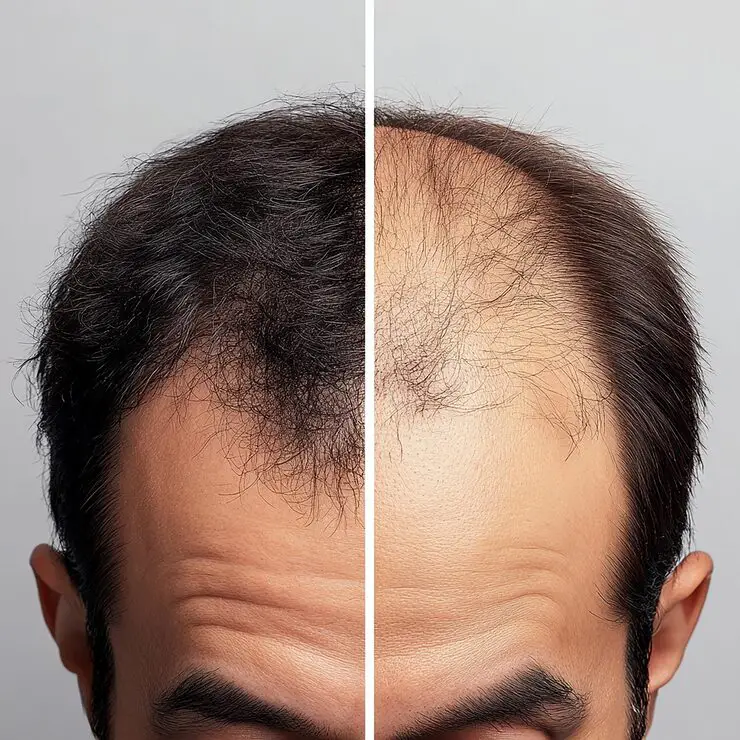
Receding hairline
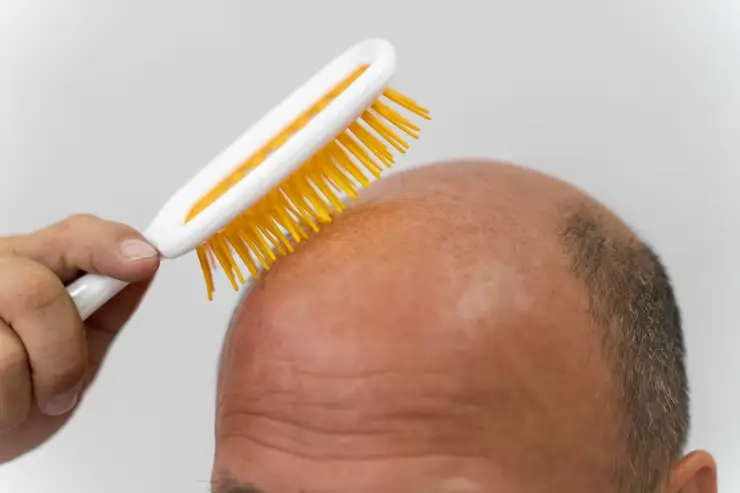
Crown hair loss

Hair loss caused by trauma or scars
Hair Transplant Techniques
At DrHairs, we use advanced transplant methods designed to achieve natural results with minimal downtime.
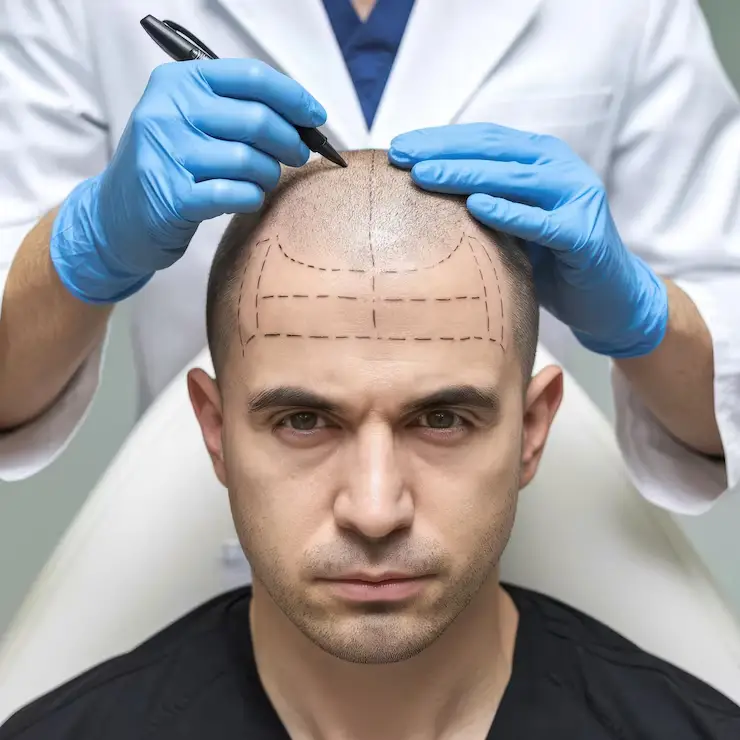
FUE – Follicular Unit Extraction
FUE is one of the most popular hair transplant techniques. Individual hair follicles are extracted from the donor area and transplanted into thinning areas.
Benefits include:
-
Minimal scarring -
Faster recovery -
Natural hairline design -
Less discomfort
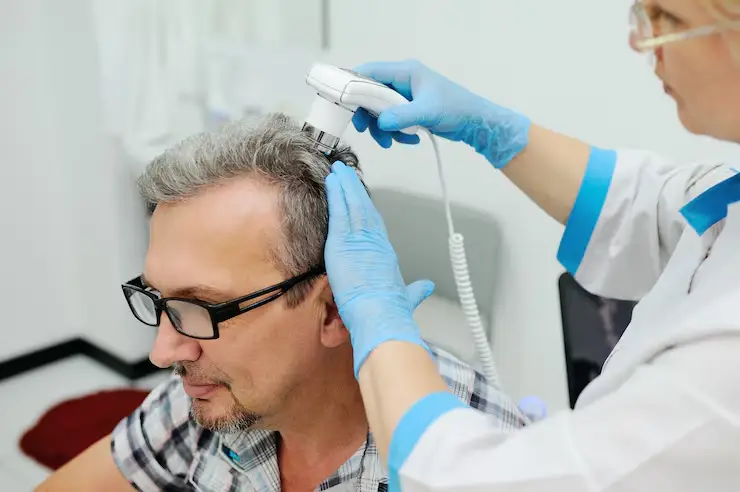
Robotic Hair Transplant Technology
In selected cases, robotic-assisted systems can be used to enhance the precision of follicle extraction and placement, improving accuracy, consistency, and graft survival.
Who performs the procedure Surgical hair transplant procedures at both our Ontario clinics are performed by physicians registered with the College of Physicians and Surgeons of Ontario. In Ontario, only a physician may administer the local anaesthetic used during a hair transplant. Non-surgical treatments are delivered by trained clinical staff under medical supervision. You can read more about our clinic and our clinical team.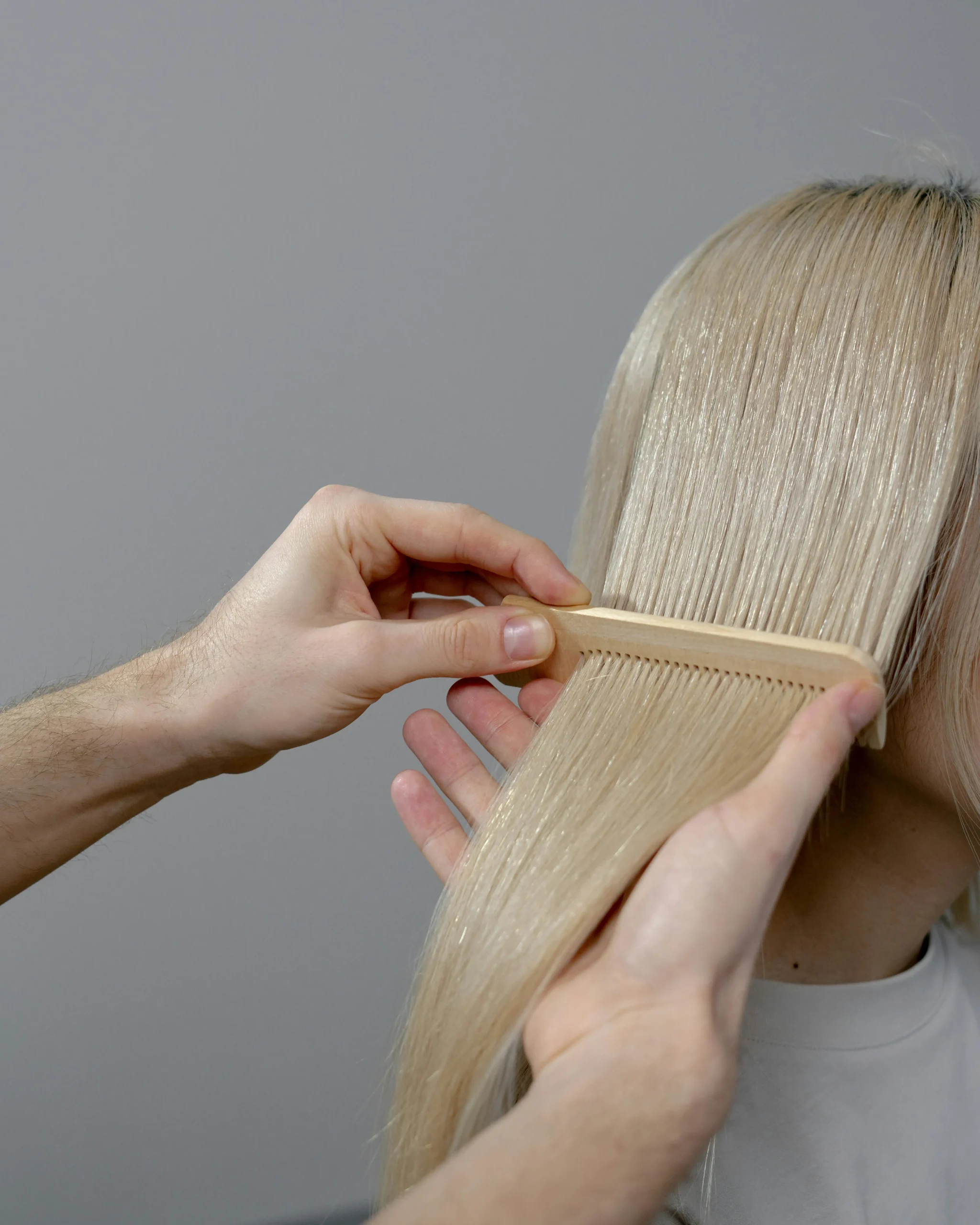
Dr Hairs Surgical team
Definition A hair transplant is a surgical procedure that relocates follicular units from a donor area — usually the back and sides of the scalp — into areas affected by permanent hair loss. It redistributes the hair you already have. It does not create new follicles, which is why donor supply is the limit on what any transplant can achieve. Follicular units are harvested using either FUE or FUT. Recipient sites are then planned across the treatment area, and the prepared grafts are placed according to the intended direction, angle and density. A transplant can improve the appearance of a receding hairline, thinning temples, frontal loss, crown thinning, selected scars, and sparse eyebrows or beard. It cannot stop hair loss elsewhere on your scalp from continuing, which is why we usually pair surgery with an ongoing plan. If you are still working out what is causing your hair loss, start with our page on hair loss. If you want to compare surgery against non-surgical options, our hair restoration guide sets them side by side.What is a hair transplant?
Harvesting methods FUE removes follicular units individually from the donor area. FUT removes a narrow strip of donor tissue, which is then divided into individual units. Neither method is automatically better — the right one depends on your donor supply, how many grafts you need, how you wear your hair, and how you feel about the two types of scarring. FUE is not scar-free surgery. It replaces one line with many small marks. They are easier to conceal, but they exist, and heavy or poorly distributed extraction can leave the donor area looking visibly thinner. Any clinic telling you a transplant leaves no mark at all is overselling it.FUE vs FUT: what is the difference?
Factor
FUE
FUT
Harvesting
Units removed individually
Narrow strip of tissue removed
Scarring
Many small circular marks across the donor area
One linear scar
Very short hairstyles
Usually more forgiving
Linear scar may show
Larger graft numbers
Possible, but time-intensive
Often better suited
Scalp laxity
Less dependent on it
Adequate laxity matters
Shaving
May need partial or wider shaving
Shaving usually more limited
Recovery
Small sites heal individually
Donor closure needs healing
Future planning
Extraction pattern must protect donor appearance
May preserve areas for later FUE
One thing worth being clear about
Planning Most patients need somewhere between 1,000 and 3,500 grafts, depending on how much area needs coverage and how advanced the loss is. The only way to know your number is a donor assessment — density, hair calibre and texture all change how many grafts are required to produce the same visual result. The ranges below are typical starting points by stage of loss. They are not a quote, and they are not a substitute for an examination. Two people at the same Norwood stage can need very different graft numbers. Thick, wavy, light-coloured hair covers more scalp per follicle than fine, straight, dark hair against pale skin. This is why online graft calculators are close to useless on their own.How many grafts will I need?
Stage
What it usually looks like
Typical graft range
Norwood 2
Slight temple recession
500–1,200
Norwood 3
Clear recession at both temples
1,000–1,800
Norwood 3 vertex
Temple recession plus early crown thinning
1,500–2,200
Norwood 4
Frontal loss with a separate crown area
2,000–2,800
Norwood 5
Larger frontal and crown areas, narrowing bridge
2,500–3,500
Norwood 6
Frontal and crown merged
3,500–4,500
Norwood 7
Only a band of donor hair remains
Donor supply usually cannot cover this fully
Ludwig I (women)
Mild widening of the part
800–1,500
Ludwig II (women)
Noticeably reduced density across the top
1,500–2,500
Candidacy You are more likely to be a candidate if your hair loss follows a recognisable pattern, your donor area is stable and dense enough to supply what you want covered, your scalp is healthy, and your expectations match what your donor supply can actually deliver. Age alone does not decide this. A stable 45-year-old and a rapidly progressing 24-year-old are very different cases even at the same Norwood stage. Straight answer We decline hair transplant surgery for a meaningful number of the people who ask us for it. That is not us being difficult — operating on the wrong candidate produces a poor result, wastes a limited donor supply, and often makes the eventual outcome worse than doing nothing. We will usually recommend against surgery, or recommend waiting, when: In those cases we will usually discuss non-surgical options, further medical assessment, scalp micropigmentation, or simply monitoring for a period before deciding.Am I a suitable candidate?
Who we turn away
Recovery and Healing
Hair transplant recovery is generally straightforward. Patients may experience mild redness, minor swelling, and temporary scabbing. Most patients return to normal activities within a few days.
New hair growth typically begins within 3–4 months, with full results visible after 9–12 months.
Who is a Good Candidate?
Hair transplant candidates typically:
-
Have stable hair loss -
Possess healthy donor hair -
Want to restore hair density -
Are in good general health
A professional consultation is necessary to determine eligibility.
The procedure We review your hair-loss history, examine your scalp and donor area, and discuss what is realistic. Hairline position, direction, angle, density distribution and likely future loss are mapped out. Pre-operative instructions are given based on your procedure and health information. The scalp is numbed with local anaesthetic, administered by a physician. Follicular units are taken by FUE or FUT. Units are prepared and sorted to minimise time outside the scalp. Sites are created to control direction, angle and density. Grafts are placed according to the plan, with single-hair units at the leading edge. Washing, sleeping, activity and follow-up instructions are provided in writing. Procedure length depends on graft numbers and method. Larger sessions can run most of a day.What happens during the procedure
Assessment
Planning
Preparation
Anaesthetic
Harvesting
Graft preparation
Recipient sites
Placement
Aftercare briefing
What Happens During the Hair Transplant Process?
-
Book Your Consultation
Contact DrHairs to arrange a hair transplant consultation at our Markham clinic.
-
Discuss Your Hair-Loss History
We discuss when your hair loss began, how it has progressed, relevant family history, previous treatments, health information and your goals.
-
Assess Your Hair and Scalp
The current hair-loss pattern, existing density, scalp condition and potential donor area are reviewed.
-
Review Donor-Hair Availability
Donor density, hair characteristics, previous harvesting and long-term capacity are considered.
-
Compare FUE and FUT
Where transplantation may be suitable, we explain which harvesting options may be considered and why.
-
Estimate Graft Requirements
The treatment area, donor capacity and realistic coverage goals help inform the preliminary graft estimate.
-
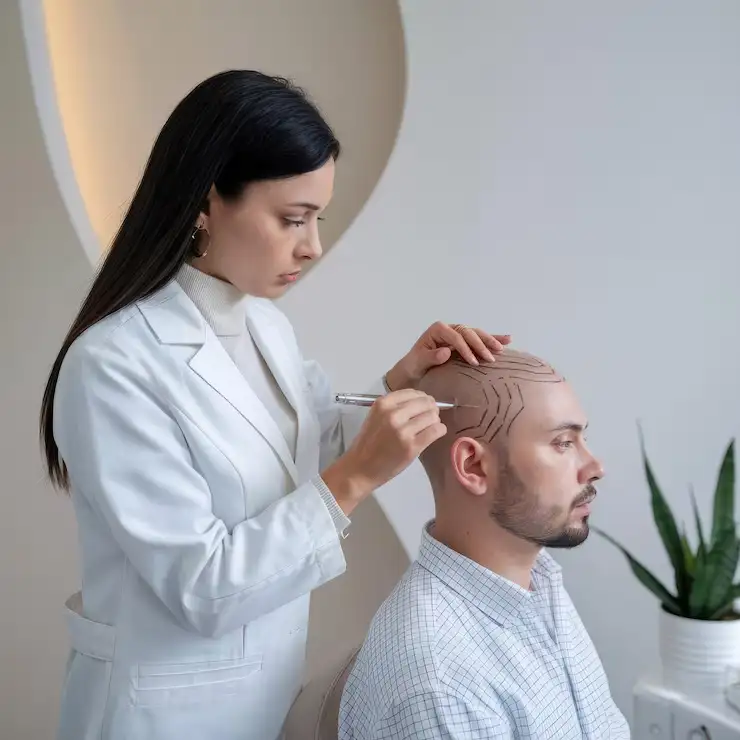
Plan the Hairline or Treatment Area
Hairline position, direction, angle, density transition and future hair loss are considered.
-
Prepare for the Procedure
Pre-operative instructions are provided according to the planned procedure and relevant health information.
-
Harvest and Prepare the Grafts
Follicular units are harvested using the selected method and prepared for placement.
-
Create and Fill Recipient Sites
Recipient sites are planned to support the intended direction, angle and distribution. Prepared grafts are then placed in the selected areas.
-
Receive Aftercare Instructions
Patients receive guidance for donor and recipient care, washing, sleeping, physical activity and follow-up.
-
Attend Follow-Up Appointments
Healing and progress are reviewed according to the recommended follow-up schedule.
The actual process may vary according to technique, treatment area and individual requirements.
Recovery Most people are back at work within two to five days, though visible redness and scabbing can last longer than that. Recovery differs between FUE and FUT, and your own instructions take priority over any general timeline. Expect redness, tenderness, some swelling and small scabs around the graft sites. Sleep with your head elevated. Follow the washing instructions exactly. Scabs gradually loosen and clear. FUT patients also manage the donor closure. Avoid heavy exercise, swimming, saunas and direct sun. Most transplanted hairs shed. This is expected and does not mean the follicle has been lost. This is the stage people find hardest, because the scalp can look worse than before surgery. New growth begins, initially fine and sparse. Nothing looks finished at three months. Density becomes visible and continues to build. Most people see meaningful development between six and nine months. Hair calibre and texture mature. Crown areas often run behind the hairline on this timeline. Contact the clinic if you develop unexpected pain, bleeding, discharge, fever or worsening swelling.What should you expect during recovery?
Days 1–3
Days 4–14
Weeks 2–8
Months 3–6
Months 6–12
Months 12–18
Longevity Transplanted follicles are taken from areas that are genetically resistant to pattern hair loss, so they generally continue growing for life. What a transplant cannot do is stop the hair around them from thinning. That is the most common misunderstanding we correct in consultations. Surgery treats what you have already lost. Protecting what you still have is a separate, ongoing job, which is why we usually pair a transplant with a maintenance plan. Not every graft survives, and no clinic can guarantee a specific outcome. Graft survival, healing and growth vary with your health, medication and how closely you follow aftercare.Are hair transplant results permanent?
Informed consent A hair transplant is surgery, and it carries real risks. These should be discussed with you before you consent, not after. Risk varies according to the individual, the procedure, clinical circumstances and aftercare.What are the possible risks and limitations?
Other procedures Selected women are good candidates, particularly where loss affects a defined area — a naturally high hairline, temple thinning, traction-related recession or a specific scar — and the donor region is stable. Female hair loss is more often diffuse, and when thinning extends into the donor area, transplantation is usually not appropriate. Beard transplants relocate scalp follicles into the beard or moustache. Planning has to account for facial hair growth direction, angle, existing pattern and long-term grooming. Eyebrow work demands tight control of direction, angle, shape and symmetry. Because scalp hair keeps growing after placement, regular trimming is needed.Hair transplant for women, beard and eyebrow
Women
Beard
Eyebrow
Before you book anywhere Most people booking a transplant are comparing three or four clinics and have no reliable way to tell them apart. These are the questions worth asking every one of them, including us.How to compare hair transplant clinics in Ontario
Ask
Why it matters
Is the physician registered with CPSO, and what is the registration number?
In Ontario only a physician may administer the local anaesthetic. You can verify any registration on the CPSO public register.
Who actually performs the extraction and placement?
Some clinics have the physician present only briefly. Ask what the doctor personally does.
Is the quote per graft or for the whole procedure?
Per-graft quotes can climb sharply once a graft number is set.
Does the price include HST?
Ontario adds 13%. On a $10,000 procedure that is $1,300.
What is included — aftercare, medication, follow-ups?
These are often billed separately.
Will you tell me if I am not a good candidate?
The most useful question you can ask. A clinic that has never turned anyone away is selling, not assessing.
Do the before-and-after photos state graft count, technique and time elapsed?
Photos without that data are marketing, not evidence.
What happens if I need a second session?
Ask how donor supply is being conserved for it.
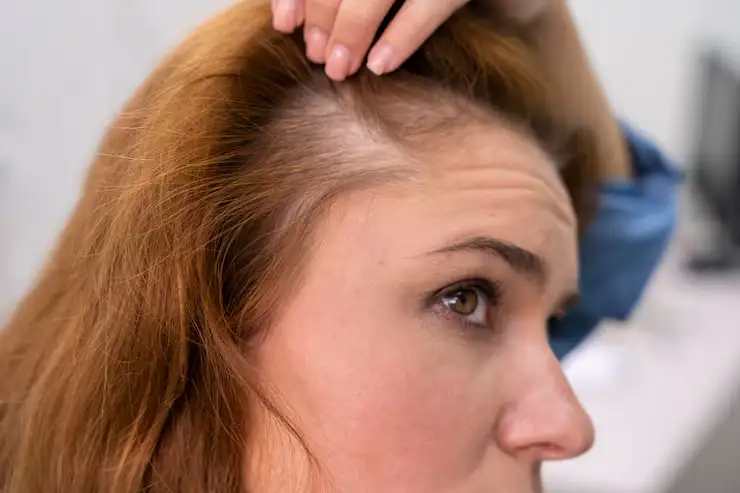
Results and Expectations
Hair transplant results develop gradually over time. Patients can expect natural hair growth, improved hair density, and permanent follicles that behave like natural hair.
Cost and coverage No. Hair transplant surgery is classified as a cosmetic procedure in Ontario, and OHIP does not fund cosmetic treatment. The narrow exception is hair loss resulting from a documented medical condition, injury or burn, and even then coverage is assessed case by case and is never automatic. Most private extended health plans in Canada take the same position. Some cover prescription hair loss medication when a physician prescribes it, so check your drug benefit specifically rather than assuming. Ontario HST of 13% applies to cosmetic procedures. If you think your situation might qualify for coverage, bring your medical records to the assessment and we will give you an honest read. This is general information about how cosmetic procedures are classified in Ontario. It is not insurance or financial advice. Confirm the terms of your own policy with your insurer.Is a hair transplant covered by OHIP?
Visit us Both clinics run the same assessment and offer the same procedures. Come to whichever is easier to reach — if you start at one and later prefer the other, that is not a problem. York Region 7080 Warden Avenue, Unit B3
Where we are: Warden Avenue just north of Steeles Avenue East, close to Pacific Mall and First Markham Place City of Toronto Centerpoint Mall, 6464 Yonge Street, Unit 116
Where we are: Inside Centerpoint Mall at Yonge Street and Steeles Avenue West Patients travel to us from across Markham, Unionville, Milliken, Middlefield, Armadale, Berczy Village and Cornell; from Willowdale, Newtonbrook, Bayview Village, Hillcrest Village and Bathurst Manor in North York; and from Richmond Hill, Thornhill, Vaughan, Scarborough, Agincourt, Aurora, Newmarket, Stouffville, Pickering and Ajax. If you are coming a long distance, tell us when you book and we will try to group your assessment and procedure to reduce trips.Two Ontario clinics
DrHairs Markham
Markham, Ontario L3R 1S2
Driving: Minutes from Highway 404 and Highway 407 · free on-site parking
Transit: York Region Transit Warden route · Milliken GO Station nearby
Hours: Mon–Fri 9:00am–6:00pm · Sat 10:00am–4:00pm
DrHairs North York
North York, Ontario M2M 3X4
Driving: Short drive from Highway 401 · free parking at the mall
Transit: TTC Line 1 to Finch Station, then north on Yonge · York Region Transit stops outside
Hours: Mon–Fri 9:00am–6:00pm · Sat 10:00am–4:00pm
Documented Clinical Results Real patient hair restoration outcomes from our Toronto & Markham clinics. Each case details the surgical technique, graft count, and documented timeline. Hair Transplant Before & After Results
Case 01 Result
Case 01: Frontal Hairline Reconstruction
Technique: FUE (Follicular Unit Extraction)
Grafts: 2,800 Grafts
Patient: Male, Age 34
Timeline: 12 Months Post-Op
Natural hairline redesign addressing Norwood Stage 3 recession. The procedure restored dense coverage across the frontal zone and temples using ultra-refined graft placement.

Case 02 Result
Case 02: Full Mid-Scalp & Crown Restoration
Technique: Advanced FUE & Medical Maintenance
Grafts: 3,400 Grafts
Patient: Male, Age 41
Timeline: 14 Months Post-Op
Comprehensive restoration for diffuse mid-scalp and vertex thinning. Multi-hair follicular units were strategically placed in the crown to match natural whorl patterns.
View Full Patient Case Gallery
Why Choose DrHairs for Hair Transplant?
At DrHairs, we focus on precision, safety, and natural aesthetics.
Our approach includes:
-
Personalized treatment planning -
Modern transplant techniques -
Natural hairline design -
Comprehensive follow-up care
Questions Our pricing starts at $3,990 plus HST for a smaller session of approximately 1,000 grafts. The final figure depends on your graft requirement, harvesting method and treatment area, all confirmed at your free assessment. Most patients need between 1,000 and 3,500 grafts. A Norwood 3 typically needs 1,000–1,800; a Norwood 5 typically needs 2,500–3,500. Your actual number depends on donor density, hair calibre and texture as well as the area being covered. Yes. FUE does not leave one linear scar, but it does leave many small circular extraction marks across the donor area. They are easier to conceal than an FUT scar, but they are permanent. The scalp is numbed with local anaesthetic, so the procedure itself is not painful, though you may feel pressure. Mild tenderness during the first few days of recovery is normal. Transplanted hair sheds within the first few weeks, then regrows. Meaningful density usually appears between six and nine months, with the final result at around twelve to eighteen months. Nothing looks finished at three months. No. Transplanted follicles are resistant to pattern hair loss, but the untreated hair around them can keep thinning. This is why we usually pair surgery with an ongoing maintenance plan. Selected women can. It works best where loss affects a defined area and the donor region is stable. Because female hair loss is often diffuse and can involve the donor area itself, careful assessment is essential. No. Hair transplant surgery is classified as a cosmetic procedure in Ontario and OHIP does not fund cosmetic treatment. Ontario HST of 13% applies. No. You can book an assessment with either clinic directly, by phone or online. Most people return within two to five days, though visible redness and scabbing can last longer. It depends on your procedure, how you heal and how visible your job is. Transplanted hairs commonly shed in the weeks after surgery as the follicles enter a resting phase. The follicle itself remains. New growth develops over the following months. Then we will not recommend surgery. Depending on your situation we may discuss non-surgical treatment, scalp micropigmentation, further medical assessment, or monitoring before making a decision. Yes. Both our Markham clinic at Warden and Steeles and our North York clinic at Yonge and Steeles run the same assessment and offer the same procedures.
Booking now
Frequently asked questions
How much does a hair transplant cost in Markham?
How many grafts do I need?
Does FUE leave scars?
Does a hair transplant hurt?
When will I see results?
Can a hair transplant stop future hair loss?
Can women have a hair transplant?
Is a hair transplant covered by OHIP?
Do I need a referral from my family doctor?
When can I go back to work?
Why does transplanted hair fall out after surgery?
What if my donor area is not strong enough?
Do you offer hair transplants at both locations?
Take the first step Find out whether a transplant is right for you, how many grafts you would need, and what it would cost — before you commit to anything. The assessment is free at both our Markham and North York clinics. Book a free assessment Individual results vary. Photographs on this website are of real patients and are provided for reference only; they do not guarantee a similar outcome. Hair restoration is a cosmetic procedure and is not covered by OHIP. All prices are in Canadian dollars and exclude HST.Book a free assessment
Markham (905) 604-0802
North York (647) 568-0000