Natural-looking, long-term facial hair restoration for patchy cheeks, uneven jawlines, and sparse facial hair. Delivered under a physician-led surgical standard of care at DrHairs.
At DrHairs, our beard transplant procedure uses Follicular Unit Extraction (FUE) to relocate selected hair follicles from a suitable scalp donor area to the beard, moustache, or sideburns.
Surviving transplanted follicles are intended to provide long-lasting growth that can generally be trimmed, shaved, and styled. Results, density and graft survival vary between patients.
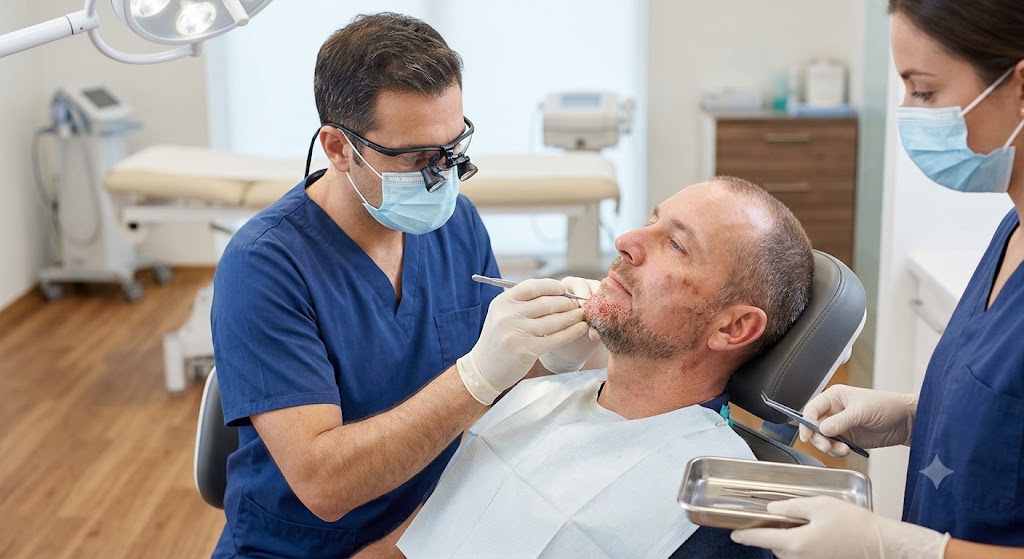
Procedure Type: Surgical FUE
Anaesthesia: Local anaesthesia
Recovery Time: 7 to 10 days
Mature Results: Commonly assessed around 12 to 18 months; timelines vary
OHIP Coverage: Cosmetic (Not covered)
A three-stage medical approach that plans growth direction, angle and density according to facial anatomy, donor supply and treatment goals.
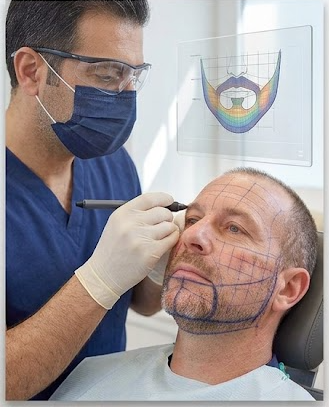
We map out your beard line and density layout to complement your facial bone structure, ensuring growth angles match natural facial hair patterns.
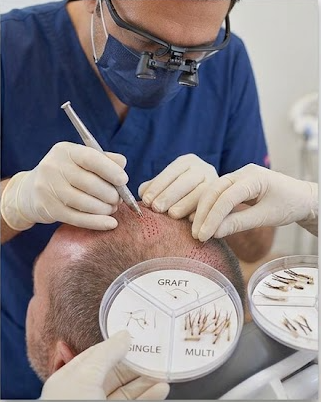
Individual follicular units are harvested using small punches from a suitable scalp donor area. FUE avoids the single linear scar associated with FUT but leaves small circular extraction marks across the donor area.
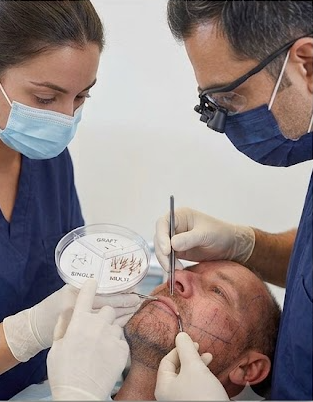
Grafts are implanted precisely into micro-sites on your face, utilizing single hairs for sharp edges and multi-hairs for fullness.
Serving patients from Markham, Toronto, Richmond Hill, Vaughan, Thornhill, Scarborough, North York, Aurora, Newmarket, Mississauga, Brampton, and the entire GTA.
Address: 7080 Warden Avenue, Unit B3, Markham, ON L3R 1S2
Phone: (905) 604-0802
Minutes from Hwy 404 & 407 · Free on-site parking
Address: Centerpoint Mall, 6464 Yonge St, Unit 116, North York, ON M2M 3X4
Phone: (647) 568-0000
Near Yonge & Steeles · Free parking at Centerpoint Mall
In Ontario, hair restoration procedures are classified as elective cosmetic treatments and are not covered by OHIP.
Your written quote explains the expected procedure fee, applicable HST and included aftercare before you decide whether to proceed.
Suitability depends on your donor supply, facial hair goals, medical history, skin condition and realistic expectations.
A beard transplant redistributes existing follicles; it does not create new ones. Donor supply limits the density and coverage that can be achieved.
Not every graft will necessarily survive, scalp hair may differ from natural beard hair, and some patients may need more than one session to pursue their goals.
Potential effects include redness, swelling, tenderness, crusting, itching, temporary numbness, bleeding, infection, folliculitis, small donor scars, uneven growth, partial graft loss or an unsatisfactory direction or density.
Some patients may require revision treatment. Your individual risks, expected benefits and alternatives are reviewed during informed consent before surgery.
Healing and growth vary. Follow the individualized instructions provided by your surgical team.
Redness, swelling, tenderness and small crusts may occur as the donor and recipient areas begin healing.
Temporary shedding of transplanted hairs is common. This does not by itself determine the final outcome.
Early growth may become visible and coverage can continue developing gradually.
A more mature result may be assessed, although density, texture and timing vary between patients.
Do not wash, rub, trim or shave the treated area until your surgical team confirms it is appropriate. Return-to-work, exercise and grooming guidance depends on your procedure and healing progress.
Local anaesthesia is used to reduce discomfort during the procedure. Patients may feel pressure during treatment and temporary tenderness, tightness, swelling or soreness afterward. Individual experiences vary.
Graft requirements vary according to the areas treated, desired density, facial dimensions, donor supply and existing facial hair. Your estimated graft number is confirmed during assessment.
Beard transplantation may improve the appearance of selected acne, surgical or burn scars. Scar thickness, blood supply and previous injury can affect graft survival, so suitability must be assessed individually.
Yes. FUE avoids one linear donor scar but leaves multiple small circular extraction marks. Their visibility depends on punch size, healing, extraction pattern and how short you wear the donor hair.
Cost depends on the estimated graft number, beard design, donor characteristics, scar tissue, procedure complexity and whether more than one session may be needed. Your written quote confirms the fee, applicable HST and included aftercare before treatment.
DrHairs delivers surgical hair restoration under a physician-led standard of care. During consultation, ask who will perform each stage of your procedure and request the physician’s name, role and CPSO registration details.
Yes! Consultations at both our Markham and North York locations are completely free, include a scalp assessment, and do not require a family doctor referral.
Meet with our medical team at DrHairs Markham or North York for an honest assessment and custom treatment plan.
Email inquiries: info@drhairs.com
We use cookies to improve your experience on our site. By using our site, you consent to cookies.
Manage your cookie preferences below:
Essential cookies enable basic functions and are necessary for the proper function of the website.
These cookies are needed for adding comments on this website.
Google reCAPTCHA helps protect websites from spam and abuse by verifying user interactions through challenges.
These cookies are used for managing login functionality on this website.
You can find more information in our Cookie Policy and Privacy Policy.
Discuss your hair concerns and find the best treatment for you.